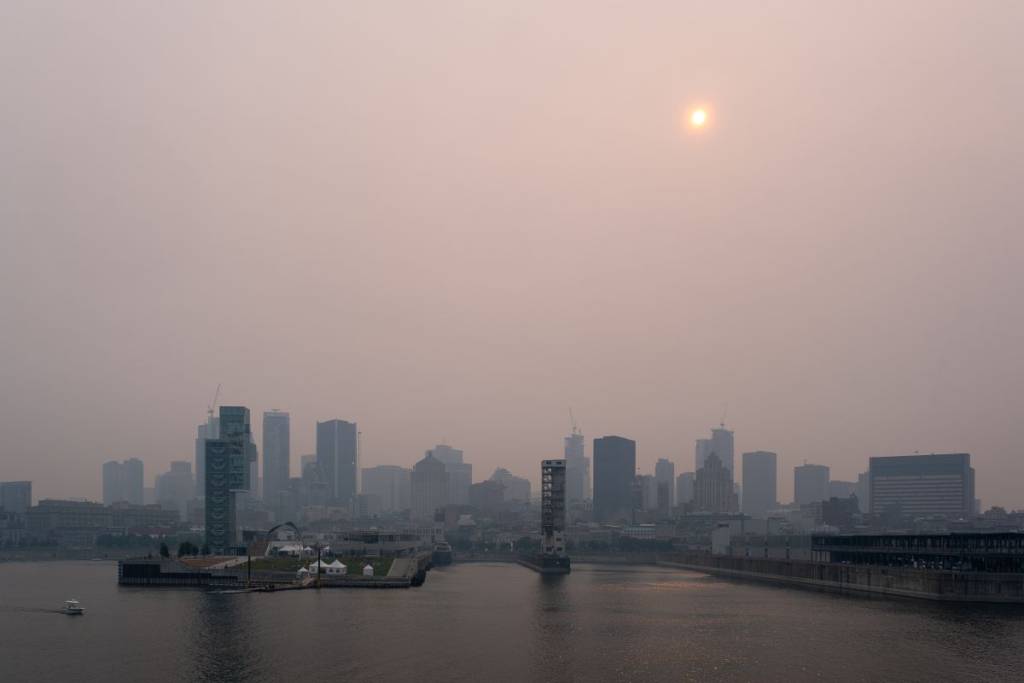

In the summer, for several days (or even weeks), there’s something strange about Montreal.The light filtering down from the clouds is reddish-orange, not white, and the sky is milky and heavy. It’s hard to breathe, our heads are spinning, and we feel drained, a little confused, and tired.
We’d love a big gulp of cool water, but we could drink liters of it without ever feeling satisfied—becausewhat we really want is a big bowl of fresh air.
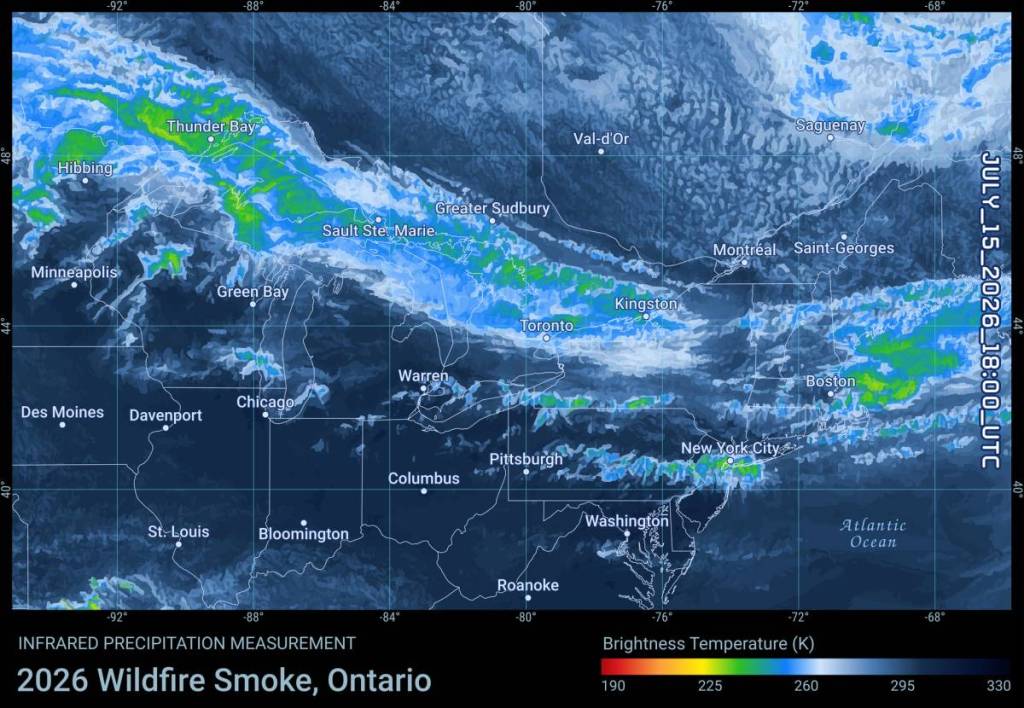
In these final days of July 2026, devastating wildfires are ravaging the province of Ontario —and while for now the smoke billowing from them is coloring the New York sky a distressing shade of blood-red orange, all it will take is for the wind to shift for Montreal to be hit by the same “smog.”
To make sure air quality doesn’t ruin our summer—or ruin visitors’ vacations—here’s everything we know aboutwildfires, Montreal’s air quality, and how to get through these hazy days in the best way possible…
“Wildfires,” the boreal forest, and global warming
In 2025, the Canadian wildfire season (May 1 to September 30) wasone of the worst in recent decades, due to conditions conducive to wildfires: temperatures above seasonal averages and low precipitation. “Wildfires” are forest fires that quickly spread and destroy everything in their path: dry fields, towns, and parched trees.
This year, in 2026, the conditions are right once again in Canada —and on the East Coast. Prime Minister Mark Carney writes:
And what about air quality?
These wildfires are producing enormous amounts of smoke, full of debris and fine particles. And every time the sky over Montreal turns from blue to orange, the newspapers (including us—we’re not above it) publish a flood of deeply alarming headlines,one-liners thatmake us want to barricade ourselves indoorsand stop breathing altogether… “You smoked 150 cigarettes yesterday,” “the worst air quality in the world today,”and so on…
While it’s true that the situation is bad and that air quality is extremely important for our quality of life and our health,today we’re going to focus on solutions to help us staycool ondays when air quality is poor.
Environment Canada’s Recommendations for Breathing Safely When Montreal’s Sky Is Smoky from Forest Fires
These recommendations apply on days when there is an air quality or air pollution alert (not every day during wildfire season, and not every day of the summer).
Those most at risk from the forest fire smoke spreading like an orange haze through the streets of Montreal are the most vulnerable people: young children, the elderly, pregnant women, immunocompromised individuals, and people with respiratory problems.
- Limiting exposure to pollution and fine particulate matter
For them, Environment Canada recommends limiting time spent outdoors (the running club will have to wait until tomorrow) and, indoors, turning on the air conditioning or a fan and keeping doors and windows closed. An air conditioning filter or an air purifier capable of filtering fine particles is also recommended.
- Wearing a mask
Even if it doesn’t bring back fond memories, it’s time to dig out the masks again… NIOSH-certified N95 masks, as well as KN95 and KF94 masks, are the ones recommended by Environment Canada.
- Drinking tea
It’s not medical advice, and it’s not scientifically proven, but there are herbs and teas that have been used for thousands of years to support and improve respiratory health.
Even if it doesn’t help flush out the harmful fine particles in the wildfire smoke we’re breathing in Montreal, we can still make an iced tea that will make us feel like we’re taking care of our family and friends during wildfire season.
These herbs are: peppermint, ginger, echinacea, anise, dandelion root, and stinging nettle.